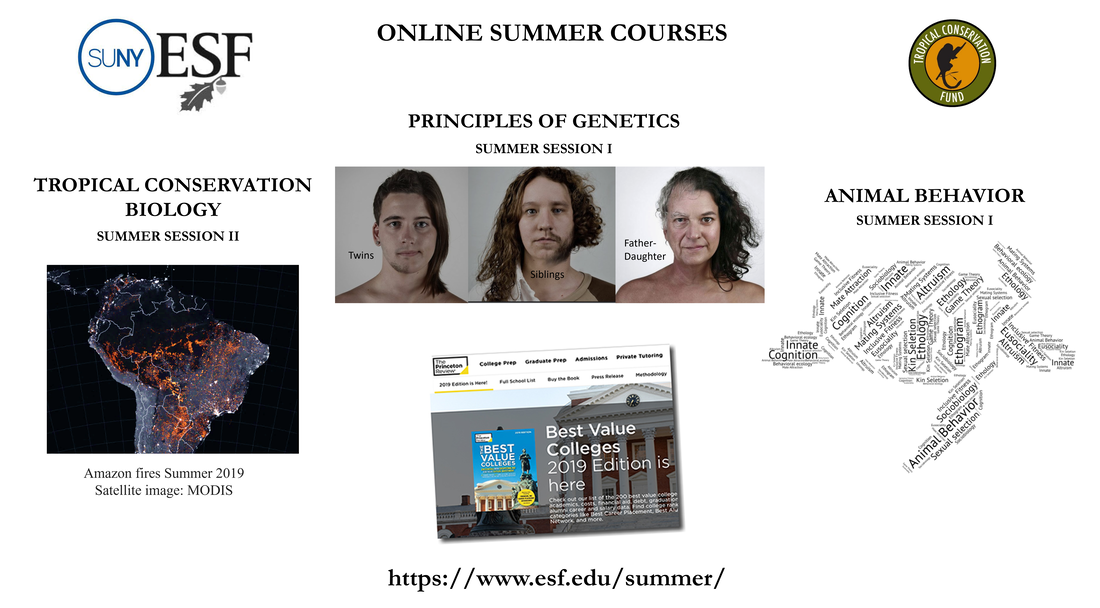
State University of New York College
of Environmental Science and Forestry (SUNY-ESF)
Visit https://www.esf.edu/summer/ for more information
- Principles of Genetics (EFB 307). Summer Session I. Online with weekly scheduled virtual meetings. Principles of Genetics (EFB 307) is an introductory course designed to provide students with a strong foundation in the concepts and applications of classical and modern genetics. Offered during Summer Session I in an online format with weekly scheduled virtual meetings, the course emphasizes both conceptual understanding and practical problem-solving skills essential for advanced study in biology, environmental science, medicine, and related fields. The central goal of this course is to prepare students to understand, describe, and analyze the fundamental principles of heredity and genetic variation. Topics will include Mendelian inheritance, chromosome behavior, molecular genetics, gene expression, mutation, recombination, and the genetic basis of evolution and development. Students will also be introduced to modern genetic tools and technologies, such as DNA sequencing, genomics, and gene editing, and will explore how these approaches are used in research, medicine, agriculture, and conservation biology. The course is structured to promote active learning and engagement. Instructional components include video lectures, virtual discussions, and question-and-answer sessions that allow students to clarify concepts and deepen their understanding. Online homework assignments will provide regular opportunities to practice problem-solving and reinforce key ideas.
- Principles of Animal Behavior (EFB 480). Summer Session I. Online with weekly scheduled virtual meetings. We will examine how natural selection, learning and cultural transmission shape the natural behaviors of animals - including people. We will explore sexual selection and mate choice, mating systems, kinship, cooperation and conflict within social systems, parental care and social behavior, foraging and anti-predator behavior, habitat selection, migration, aggression, play and the role of communication in mediating interactions among individuals, and the role of genes, environments and learning in regulating behavioral diversity. We will seek to understand both the proximate mechanisms underlying behavior and ultimate evolutionary reasons for the existence of a behavior. You will learn a logical framework within which all aspects of animal behavior can be examined. I draw on examples from across the animal kingdom to illustrate the complex mechanisms underlying adaptations, and complement these with natural history videos that highlight key concepts. We will evaluate the scientific rigor of studies used to test theory, and highlight the often ingenious methods adopted by researchers to understand animal behavior. Note: there is an extensive field component where you will develop and test hypotheses related to animal behavior.
- Evolution (EFB 496). Summer Session II. Online with weekly scheduled virtual meetings. Evolution (EFB 496) is an upper-level course that provides a comprehensive introduction to the fundamental processes that shape biological diversity across temporal and spatial scales. Offered during Summer Session II in an online format with weekly scheduled virtual meetings, the course emphasizes both the mechanisms of evolutionary change and the patterns they produce, integrating theory, empirical evidence, and contemporary research. The course begins by examining the core evolutionary processes that drive changes in populations over time, including mutation, genetic drift, gene flow, natural selection, and sexual selection. Students will explore how these forces interact to influence allele frequencies, adaptation, and genetic variation, and how evolutionary outcomes depend on ecological context and historical constraints. Particular attention is given to the evolution of life-history strategies, trade-offs among survival, growth, and reproduction, and the role of phenotypic plasticity in allowing organisms to respond to environmental variability. Building on these microevolutionary foundations, the course transitions to macroevolutionary patterns and processes that shape diversity over deep evolutionary time. Topics include speciation and extinction, the dynamics of adaptive radiations, coevolutionary interactions among species, and the evolutionary consequences of mass extinctions. Students will also learn how evolutionary relationships are inferred through the reconstruction and interpretation of phylogenies, using both morphological and molecular data to understand the history of life. A central goal of the course is to develop students’ ability to think scientifically and to evaluate evolutionary hypotheses using evidence from genetics, paleontology, ecology, and comparative biology. Course activities include video lectures, virtual discussions, and guided problem-solving sessions, along with readings from primary scientific literature. Students will engage in analytical assignments and discussions that emphasize data interpretation, critical evaluation of scientific arguments, and synthesis across evolutionary scales.
- Tropical Conservation Biology (EFB 496). Summer Session II. Online with weekly scheduled virtual meetings. Tropical Conservation Biology (EFB 496) is an upper-level course that introduces students to the principles and practice of conservation biology with a particular focus on tropical ecosystems, which harbor the majority of Earth’s biodiversity and face some of the most severe conservation challenges. Offered during Summer Session II in an online format with weekly scheduled virtual meetings, the course emphasizes the integration of biological science with social, economic, and political perspectives to address real-world conservation problems. The central objective of the course is to demonstrate how foundational biological knowledge, including ecology, evolution, and genetics, can be applied within a broader interdisciplinary framework to achieve the goals of biological conservation. Students will explore conservation biology as a mission-driven science that operates at the interface of research, management, and policy, particularly in regions where biodiversity conservation is closely linked to human livelihoods and development pressures. Core themes addressed throughout the course include biodiversity, its global distribution, ecological and evolutionary value, and methods of measurement, as well as the major threats to biodiversity, such as habitat loss and fragmentation, climate change, overexploitation, invasive species, and emerging diseases. The course also examines the philosophy, tools, and applications of conservation biology, including reserve design, population viability analysis, restoration ecology, and community-based conservation strategies. Students will evaluate the effectiveness of different conservation approaches and consider ethical questions surrounding species preservation, ecosystem services, and environmental justice. Case studies from tropical forests, coral reefs, savannas, and freshwater systems will be used to illustrate conservation challenges and solutions across diverse ecological and cultural contexts.
All aspects of offered courses are online, utilizing video lectures, recitations, computer-based laboratories and virtual resources. These online courses are likely different than your traditional classroom experience. However, please note that these courses are equivalent in every other way in terms of material covered. There are many advantages to the online learning environment, mainly that you have access to all the materials and services for the course so that you can immerse yourself in a multi-media rich environment whenever and as often as you like.
There are weekly virtual meetings to enhance your learning experience. I establish times that are conducive to your schedules. If you have questions, please email me.
For registration details, please visit SUNY ESF (Summer Semester).